Vela · 2025
How setren designed and built a real-time operations dashboard that gives fleet managers visibility across hundreds of industrial vehicles, reducing downtime by 40%.
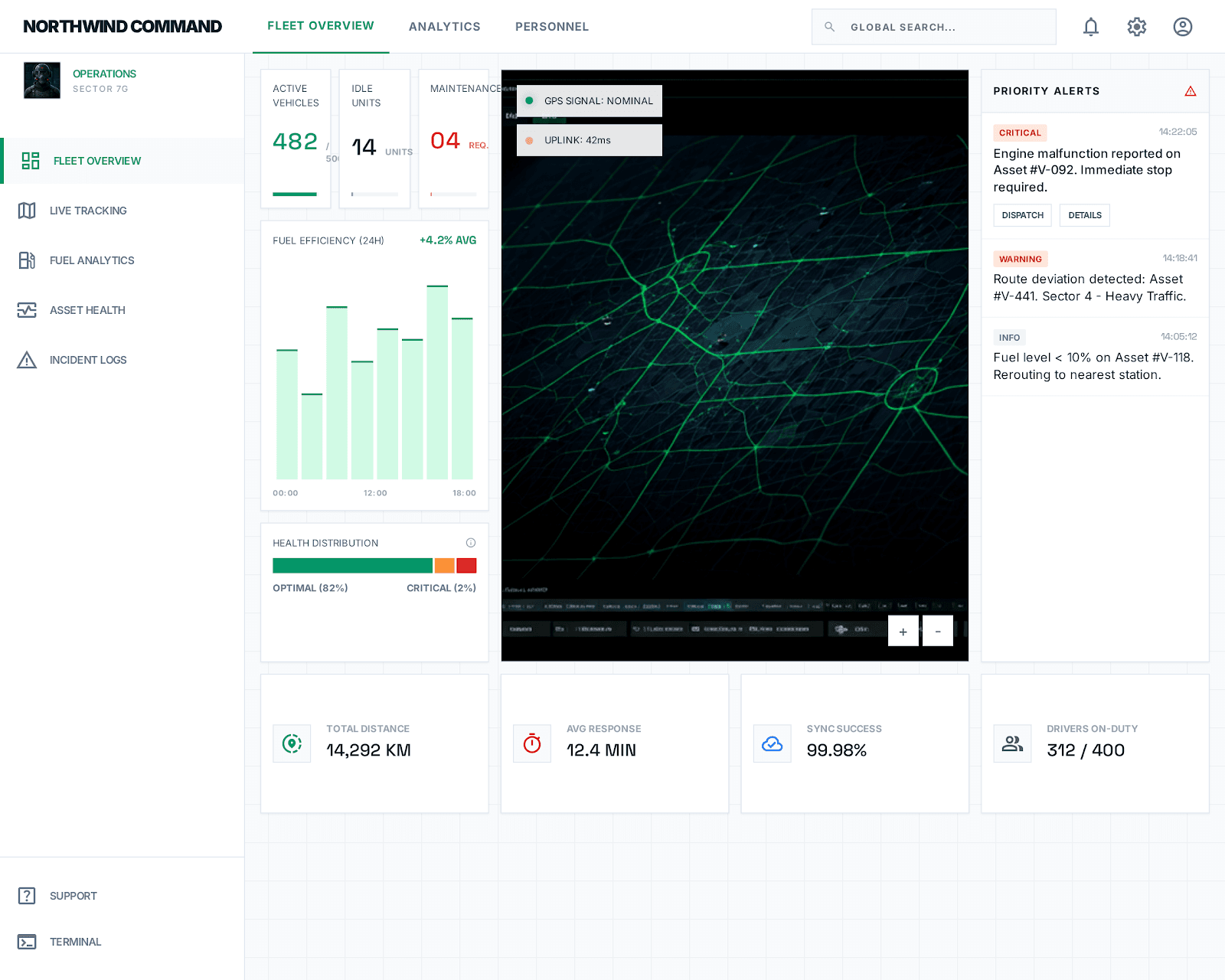
Northwind Command manages industrial fleets — heavy machinery, logistics trucks, and utility vehicles spread across remote sites in Kalimantan and Sumatra. Their operations team was drowning in spreadsheets and WhatsApp messages. Vehicle status, maintenance schedules, fuel consumption, and driver assignments were tracked in five different systems that never talked to each other. When a truck broke down at a mining site, it could take hours just to figure out which mechanic was closest and what parts were available. Northwind needed a single dashboard that unified every data source into a real-time operational view — and it had to work on spotty satellite internet connections in the field.
We ran a week-long discovery at Northwind's Jakarta headquarters and two field sites in South Kalimantan. The key insight: fleet managers don't need more data — they need fewer decisions. Every screen in the dashboard was designed around a single question: what needs my attention right now? We built a Next.js application with a WebSocket layer for real-time vehicle telemetry. The map view shows fleet positions, status indicators, and predicted maintenance windows. We designed an alert priority system that surfaces only actionable items — a vehicle due for service in 48 hours, a fuel anomaly, a driver approaching hours-of-service limits. The backend aggregates data from GPS trackers, OBD-II sensors, fuel card APIs, and the existing ERP via a unified event pipeline. We optimized aggressively for low-bandwidth conditions: the dashboard loads under 2 seconds on a 3G connection using incremental static regeneration and aggressive edge caching.
The dashboard went live in February 2025 across Northwind's entire fleet of 340 vehicles. Unplanned downtime dropped 40% in the first quarter as predictive maintenance alerts caught issues before they became breakdowns. Dispatch response time improved from an average of 3 hours to 25 minutes. The operations team went from five tools to one. Northwind's COO presented the dashboard at an industry conference in Singapore, calling it the most impactful operational change they'd made in five years.
“We went from five systems and constant firefighting to one screen that tells us exactly what needs attention. setren understood our operations better than vendors who've been in logistics for decades.”
We design dashboards and operational tools that turn complex data into clear decisions. Real-time, performant, built for the field.
[email protected] →